

Wheelchair Van Faqs
Answers to commonly asked questions about wheelchair vans for sale.
A survey was conducted by The Martec Group, an independent market research and consulting practice, with 100 mobility service technicians to find out what wheelchair van conversion they recommend. You can learn more about the results of the survey here.
It can be very difficult to sell a wheelchair equipped vehicle on your own, so we’ve created a resource to connect you with a dealer who will purchase your vehicle. Simply fill out the form on our resource page, and one of our 104 accessible vehicle dealers will call you with an offer.
Yes! Click Here to visit our rental resource page.
Please visit our finance resources page to learn more about the options available for financing your vehicle.
The technology for driving controls is expanding every day. From basic mechanical hand controls to hi-tech drive-by-wire systems, there is equipment to fit a wide range of needs. Whether you’re exploring various lift options available, looking to learn about hand controls and adaptive seating options, or simply want to browse all available equipment, visit our equipment page to learn more about the adaptive driving options that are available to you. Or talk to a mobility specialist to learn about the options available to get you back on the road!
Check out our resource page to learn more about the conversion of an existing vehicle.
*While consumers can have their own vehicle converted or purchase an approved vehicle and have it converted, we do not recommend this! If you would like to explore this option, talk to a mobility dealer near you before purchasing a vehicle. Do not ask a regular dealership. It is very important to talk to your local mobility dealer prior to any purchase to ensure that the application will work with the vehicle you plan to purchase.
Due to the lowering of the floor to make the vehicle wheelchair accessible, there are no all-wheel drive vehicles available.
Estimated MPG from highest to lowest overall:
- Ford Transit Connect (24 City / 29 Highway)
- Nissan NV200 (24 City / 26 Highway)
- Chrysler Pacifica (19 City / 28 Highway)
- Honda Odyssey (19 City / 27 Highway)
- Toyota Sienna (19 City / 27 Highway)
- Chevrolet Traverse (18 City / 27 Highway)
- Dodge Grand Caravan (18 City / 24 Highway)
- Ford Transit (15 City / 19 Highway
Rear entry vehicles are generally less expensive, but side entry vehicles are more common and therefore have a higher resale value. The right selection will depend on your particular circumstances. Refer to our Conversion Types blog post to learn more about which conversion is right for you.
Although no vehicle allows for both rear and side entry at the same time, all of our minivans allow for either rear or side entry wheelchair ramps. SUV’s, like the Chevrolet Traverse, allow for only side entry.
Aside from price differences due to mileage and model, handicap van prices vary based on the type of conversion.
Conversions from least to most expensive:
- Manual Rear Entry Conversion—the operator will have to open the door and manually pull down the ramp.
- Power Rear Entry Conversion—both the door and the ramp are operated with power (similar in price to Manual Side Entry Conversions).
- Manual Side Entry Conversion—the operator will have to open the door and manually pull out the ramp.
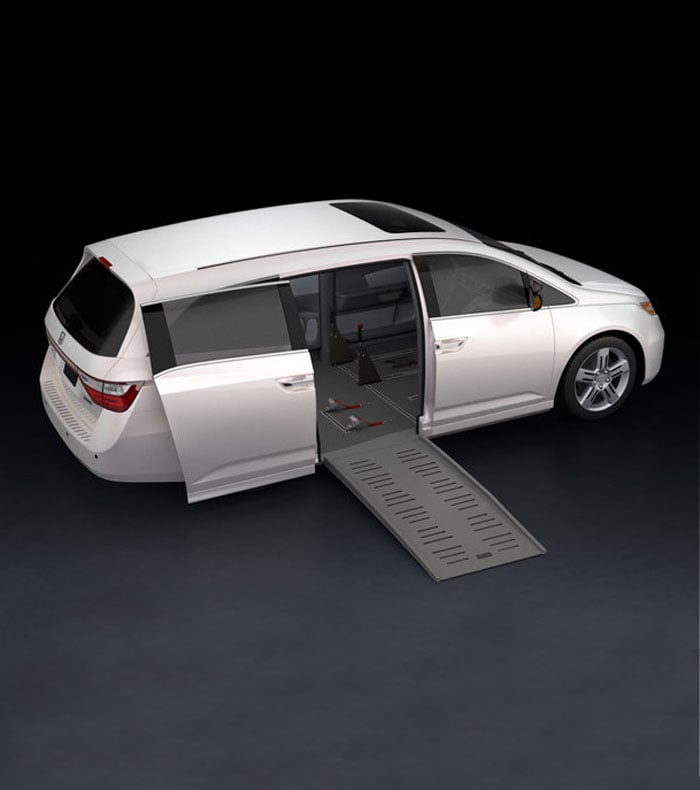
- Power Side Entry Conversion—both the door and the ramp are operated with power. The ramp fold out from the passenger side door opening.
- Power Side Entry Infloor Conversion—both the door and the ramp are operated with power. The ramp slides out from under the floor.
Purchasing a “New-Used” conversion vehicle can also help cut costs. A New-Used conversion is when a dealer installs a new wheelchair accessible conversion on a used vehicle. Dealers will buy unconverted vehicles at auctions (typically the current model year or one model year old with 15-25,000 miles) and then install a brand-new wheelchair conversion on the van. This is done so that the buyer will have a warranty on both the vehicle and the conversion.
Yes. The seating capacity of a wheelchair accessible van varies based on whether you choose a side or rear entry vehicle, and where the wheelchair will ride.
With a typical side entry conversion, whether in an SUV or a minivan, the center seats are removed leaving five seats plus the wheelchair. The wheelchair may be used to replace one of the front seats if the wheelchair van has removable seats.
Rear entry conversions, in most cases, require the back sofa to be removed from the vehicle unless a flip-up sofa option is available on the wheelchair conversion. Keeping the center seats in a rear entry conversion will depend on the size of the wheelchair.
For further information, please refer to our Conversion Types blog post which compares rear and side entry conversions in greater detail.
Driving controls are available for most vehicles, including cars, minivans and full-size vans, pickup trucks, SUVs, crossover vehicles and wagons. However, the type of controls you need may not be available for ALL vehicles. Talk with your local Mobility Resource Dealer before making any vehicle purchase to find out what works best for you
In many cases, yes. Your local Mobility Resource dealer can show you a variety of options that allow you to drive from your wheelchair, including electric tie-down systems, steering controls and more. Transfer seats are also available to help you transfer from your wheelchair tie-down system will be needed to secure the wheelchair in case of sudden stop, start, or turn. If you plan to remain in the wheelchair while traveling, then both a wheelchair restraint system and occupant restraint system will be required. Your local Mobility Resource dealer can assess your particular situation and install the required safety systems in your vehicle.
No. Driving or even riding as a passenger while in your scooter is NOT recommended. For safe operation, you should always transfer to a properly installed automotive seat. Your local Mobility Resource dealer can show you the options available to make transferring safe and easy, including the Bruno’s transfer seat. A scooter should also be restrained with an appropriate wheelchair tie-down system to secure the scooter in the vehicle in case of a sudden stop, start, or turn. If the driver has physical limitations, The Mobility Resource always recommends an evaluation by a Certified Driver Rehabilitation Specialist (CDRS) prior to driving. A CDRS can evaluate your physical abilities and prescribe adaptive equipment, if necessary, to promote a safe driving experience for all.
It depends on what type of entry your vehicle allows.
Rear-entry: Provides wheelchair or scooter access in narrow garages and standard parking lots without having to use specifically designed parking spaces. Larger scooters or tilt-space wheelchairs typically require more maneuvering room, so again, the rear-entry vehicle is the best solution.
Side-entry van: A good solution if you live in or travel to places where you may need to parallel park, or where you need to access your vehicle while parked on the streets, especially in inclement weather. Also appropriate if the wheelchair or scooter can be maneuvered inside the vehicle, or if you prefer to enter and exit in the forward-facing position.
All these factors and more play an important part in selecting the proper vehicle. A dealer in The Mobility Resource network near you will share knowledge with you to help you choose the most appropriate vehicle for your needs. You can also try out different types of adaptive vehicles so you can be sure to find the right solution to fit your needs.
One of the mobility experts can help you by reviewing your specific needs and goals. If you would like to drive from your wheelchair, the side-entry fold-out ramp may provide the best solution because it provides the most flexibility. It allows for easy exit from the vehicle in case the power fails for any reason.
1. Drivers position. With removable front seats, you can remain in your wheelchair and roll right up into the driver position. Transferring to a factory seat is also easy with the addition of a six-way power transfer seat that slides back, turns sideways and raises and lowers to the optimum transfer height.
2. Passengers position. If you use a wheelchair and are only going to be a passenger, either the side or rear-entry van will work, depending on other circumstances.
3. Driver and passenger positions. You may want to consider the side-entry fold-out ramp with removable front seats. It allows the wheelchair user or others to access either seat in front, or to ride from the middle position in the van even with other passengers seated in the rear. A rear-entry van allows the person in the wheelchair to use a transfer seat to access the front driver or passenger seat, but does not allow access to the front seats with the wheelchair.
4. Traveling alone. If you travel alone, the side-entry fold out ramp may be the best solution as discussed above. However, if others need to access the rear of the vehicle, an in-floor side-entry ramp may be your best bet. In-floor ramps slide into a compartment below the better solution if an attendant needs to accompany the person in the wheelchair. This type of van allows you to roll the wheelchair to a position between the two middle seats of the van so others can sit next to the wheelchair.
Not difficult at all. In fact, most side-entry minivans are fully automatic and deploy from the van with the push of a button. When you are done using the ramp to enter the van, you just push another button to stow the ramp and close the door.
Handicap vans with manual ramps are very easy for your loved ones to operate as well. Springs in the ramp take away much of the weight, making deploying the ramp and stowing it fast, safe, and easy. Rear-entry minivans work much the same way as side-entry vans, with either fully automatic or assisted manual conversions.
Interactive
Solutions Tool
There has never been a better time for drivers and passengers with disabilities. The newest and best technology has given opportunities never known to our peers a few years ago. Learn more about the features available to you with our interactive solutions tool.

Learn more about The Mobility Resource, featuring the largest independent dealer network in the nation.

Connect with a dealer that accepts all vehicles for trade-in towards a new accessible vehicle purchase.

Find answers to the most commonly asked questions and stay up-to-date with the latest innovations in adaptive driving.